
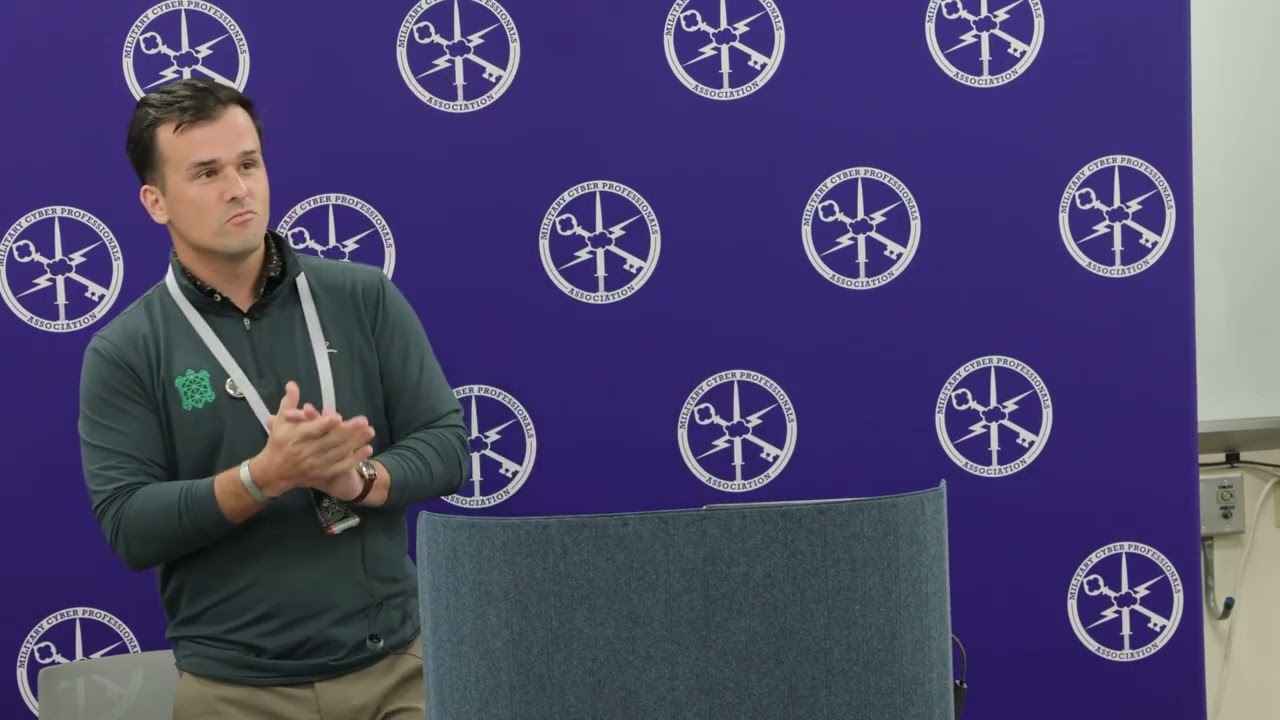
The Military Cyber Professionals Association has posted the recording of Andrew Schoka's talk from HammerCon 2026, "Attacking AI at the Data Layer: Offensive Cyber Operations and the Emerging AI Security Discipline." Andrew, Hardshell's co-founder and CEO, delivered the talk on September 24 in the Growing Innovations in Tech track at the Johns Hopkins University Applied Physics Laboratory in Laurel, Maryland.
HammerCon is the MCPA's annual national convention for the American military cyber community. The fifth edition ran under the theme Mastery in Action: Vigilant, Vicious, Victorious, with tracks for cyber operations, academic research and private-sector solutions alongside hands-on technical villages.
The talk makes one argument in fifteen minutes. Most AI security tooling watches the model, meaning prompts going in and outputs coming out. An offensive operator looks somewhere else. The training set, the corpus an AI knowledge base retrieves from, and the pipeline that moves data between them decide what a model knows and what it will reveal, and they are reachable without touching the model at all. Andrew walks through the techniques that follow from that view, including training-data poisoning, extraction and membership inference against deployed models, and retrieval paths that return documents a user was never cleared to see, with no exploit involved.
The second half is the national security case. The Department of Defense and the Intelligence Community are fielding models trained and grounded on sensitive data, and the attack classes above do not map to the categories a security operations center is built to detect. There is no malware, no credential misuse and often no network event. The talk closes on where defense has to move: measuring what a dataset or knowledge base can be made to leak before a model goes live, enforcing access at retrieval time, and hardening data upstream of training. That is the layer Hardshell works on, and the talk is vendor-neutral by design.
Andrew is a former U.S. Army Cyber Corps officer with assignments across U.S. Cyber Command, Joint Special Operations Command, the National Security Agency and U.S. Army Intelligence and Security Command, and teaches graduate cybersecurity at the University of Virginia School of Engineering. The MCPA is a 501(c)(3) educational nonprofit that develops American military cyber professionals and invests in STEM education.
Watch the full talk on the MCPA's YouTube channel →
Video and cover image: Military Cyber Professionals Association.