
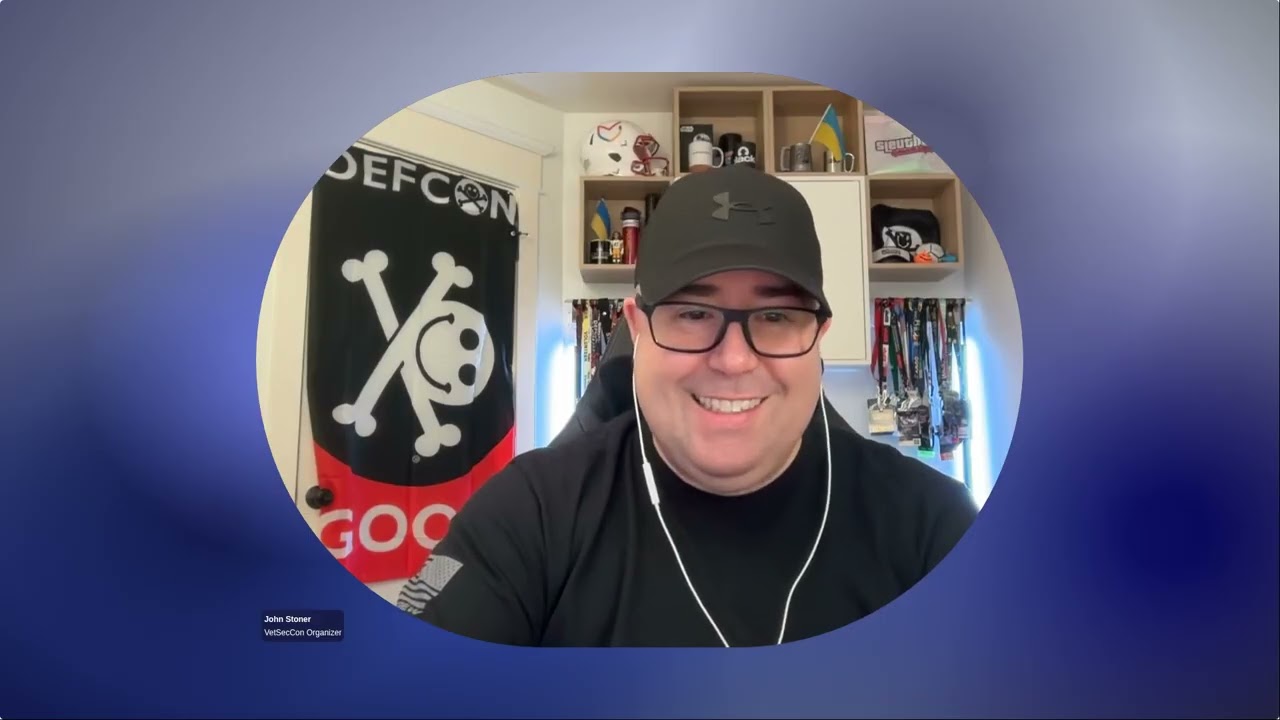
VetSec has posted the recording of Andrew Schoka's talk from VetSecCon 2026, "Breaking Into AI Security." Andrew, Hardshell's co-founder and CEO, gave the talk on October 24, the final day of the three-day virtual conference. The video below starts at his talk, which runs about 28 minutes within VetSec's full Day 3 stream.
VetSecCon is VetSec's annual conference for veterans working in or moving into cybersecurity. The Day 3 program covered SaaS security, help desk impersonation attacks, nation-state threats and the safe use of AI agents in cyber operations, alongside sessions on leadership, career transitions and building security teams.
The talk opens with a comparison to cloud security about fifteen years ago. Demand for AI security talent is climbing because nearly every company is trying to put AI to work, and in Andrew's experience most of the implementation problems are data access problems, which makes them security problems. The field has no standard job titles yet, so an AI assurance engineer, an AI red team operator and an AI security engineer can describe close to the same work. There's no dominant certification either, and frameworks like the EU AI Act, ISO/IEC 42001 and MITRE ATLAS are still settling. That puts the premium on demonstrated experience.
Andrew argues that this works in veterans' favor. The work happens under real uncertainty, with few established threat models, frameworks or tools. Veterans tend to write well for decision makers, which matters in a market crowded with AI-enabled security products. And much of the federal AI red teaming and AI security work requires a clearance, a process many veterans have already been through.
From there, the talk maps the work lanes taking shape in the field:
- AI red teaming
- Application and agent security
- Data-layer security, where Hardshell works
- Model supply chain
- Detection and response
- Threat intelligence and abuse
- Governance and assurance
Each lane connects to backgrounds common in the military and intelligence community, from defensive cyber and SOC work to signal, network and systems specialties and data and analytics roles.
The last section covers what Andrew looks for when Hardshell hires:
- Proof of work, such as a write-up of building a small LLM application or retrieval system and then breaking it on purpose
- A working understanding of how models are trained and how LLM applications are built
- The ability to explain a risk and its tradeoffs to a customer or stakeholder in a single screen of email
- Genuine curiosity about the field, the one quality he can't teach after someone is hired
His advice on the new AI security certifications is to use them to structure study. None has been around long enough to carry much weight in hiring yet.
Andrew closes with three steps for anyone looking to move into the field: pick one lane, build something small on a model or retrieval system and try to break it, then talk publicly about what you learned. He also points to SkillBridge, the Honor Foundation and Hiring Our Heroes as ways into regulated enterprises, where AI security teams tend to be small and specialized, and uses his own recent attempt to build an agent to run as Hardshell's office manager as an example of how much a small project teaches.
Andrew is a former U.S. Army Cyber Corps officer with assignments across U.S. Cyber Command, Joint Special Operations Command, the National Security Agency and U.S. Army Intelligence and Security Command, and teaches graduate cybersecurity at the University of Virginia School of Engineering. Hardshell's open roles are listed on the careers page.
Watch the full talk on VetSec's YouTube channel →
Video and cover image: VetSec.